What this page covers
What does the Bible say about being forgiven and forgiving others?
Forgiveness received from God and extended to others, including what forgiveness does not require. Reconciliation of relationships will be treated separately when that page is ready.
Scripture speaks of forgiveness in two directions that it refuses to separate: God forgiving people, and people forgiving one another. The Lord’s Prayer asks for both in one line, and Jesus immediately underlines the connection (Matthew 6:14–15).
Without limit
When Peter asks whether forgiving someone seven times is enough, Jesus answers “seventy times seven” (Matthew 18:21–22) — not a higher quota but the end of counting. The parable that follows tells of a servant forgiven an enormous debt who then refuses to forgive a small one. The study guide Forgiveness in the Gospels walks through it with discussion questions.
The pattern
Paul summarizes the logic in Ephesians 4:32: forgive “just as God also in Christ forgave you.” Forgiveness is first received, then extended. The most demanding example is Jesus Himself, praying for those who crucified Him (Luke 23:34).
What forgiveness is not
Forgiving is not pretending a wrong did not happen, and it is not the same as reconciliation, which requires both parties. Scripture names sin honestly even as it calls for forgiveness. Pastoral writers in every tradition note that forgiving someone who has caused serious harm does not require remaining in danger, and that forgiveness can be a long process rather than a single moment.
Different traditions, shared ground
Catholic and Orthodox Christians receive God’s forgiveness through the sacrament of reconciliation (confession) as well as in prayer; many Protestant traditions emphasize direct confession to God and mutual confession among believers (James 5:16). All affirm the promise of 1 John 1:9: God is faithful to forgive.
Passages, in context
And be kind to one another, tender hearted, forgiving each other, just as God also in Christ forgave you.
Estote autem invicem benigni, misericordes, donantes invicem sicut et Deus in Christo donavit vobis.ad Ephesios 4:32 · Clementine Vulgate
Forgive as God in Christ forgave you: the pattern and the reason in one sentence.
Paul on life in a new community

Then Peter came and said to Him, “Lord, how often shall my brother sin against me, and I forgive him? Until seven times?” Jesus said to him, “I don’t tell you until seven times, but, until seventy times seven.
Tunc accedens Petrus ad eum, dixit: Domine, quoties peccabit in me frater meus, et dimittam ei? usque septies? Dicit illi Jesus: Non dico tibi usque septies: sed usque septuagies septies.Matthæus 18:21–22 · Clementine Vulgate
Peter suggests a generous limit — seven times. Jesus’ answer removes the limit altogether.
Introduces the parable of the unforgiving servant

“For if you forgive men their trespasses, your heavenly Father will also forgive you. But if you don’t forgive men their trespasses, neither will your Father forgive your trespasses.
Si enim dimiseritis hominibus peccata eorum: dimittet et vobis Pater vester cælestis delicta vestra. Si autem non dimiseritis hominibus: nec Pater vester dimittet vobis peccata vestra.Matthæus 6:14–15 · Clementine Vulgate
Jesus’ comment right after the Lord’s Prayer ties forgiving others to receiving forgiveness.
The Sermon on the Mount
Jesus said, “Father, forgive them, for they don’t know what they are doing.” Dividing His garments among them, they cast lots.
Jesus autem dicebat: Pater, dimitte illis: non enim sciunt quid faciunt. Dividentes vero vestimenta ejus, miserunt sortes.Lucas 23:34 · Clementine Vulgate
Jesus prays for forgiveness for those crucifying Him — the most demanding example in the Gospels.
At the crucifixion
He has not dealt with us according to our sins,
nor repaid us for our iniquities.
For as the heavens are high above the earth,
so great is His loving kindness toward those who fear Him.
As far as the east is from the west,
so far has He removed our transgressions from us.
Non secundum peccata nostra fecit nobis, neque secundum iniquitates nostras retribuit nobis. Quoniam secundum altitudinem cæli a terra, corroboravit misericordiam suam super timentes se; quantum distat ortus ab occidente, longe fecit a nobis iniquitates nostras.Vulgate Psalm 102:10–12 · Clementine Vulgate
God removes our transgressions “as far as the east is from the west.”
A psalm of praise attributed to David
If we confess our sins, He is faithful and righteous to forgive us the sins and to cleanse us from all unrighteousness.
Si confiteamur peccata nostra: fidelis est, et justus, ut remittat nobis peccata nostra, et emundet nos ab omni iniquitate.1 Joannis 1:9 · Clementine Vulgate
Confession and forgiveness: God is faithful to forgive those who acknowledge their sins.
The First Letter of John
bearing with one another, and forgiving each other, if any man has a complaint against any; even as Christ forgave you, so you also do.
supportantes invicem, et donantes vobismetipsis si quis adversus aliquem habet querelam: sicut et Dominus donavit vobis, ita et vos.ad Colossenses 3:13 · Clementine Vulgate
Bear with one another and forgive — forgiveness as ongoing practice in community.
Paul to the Colossians
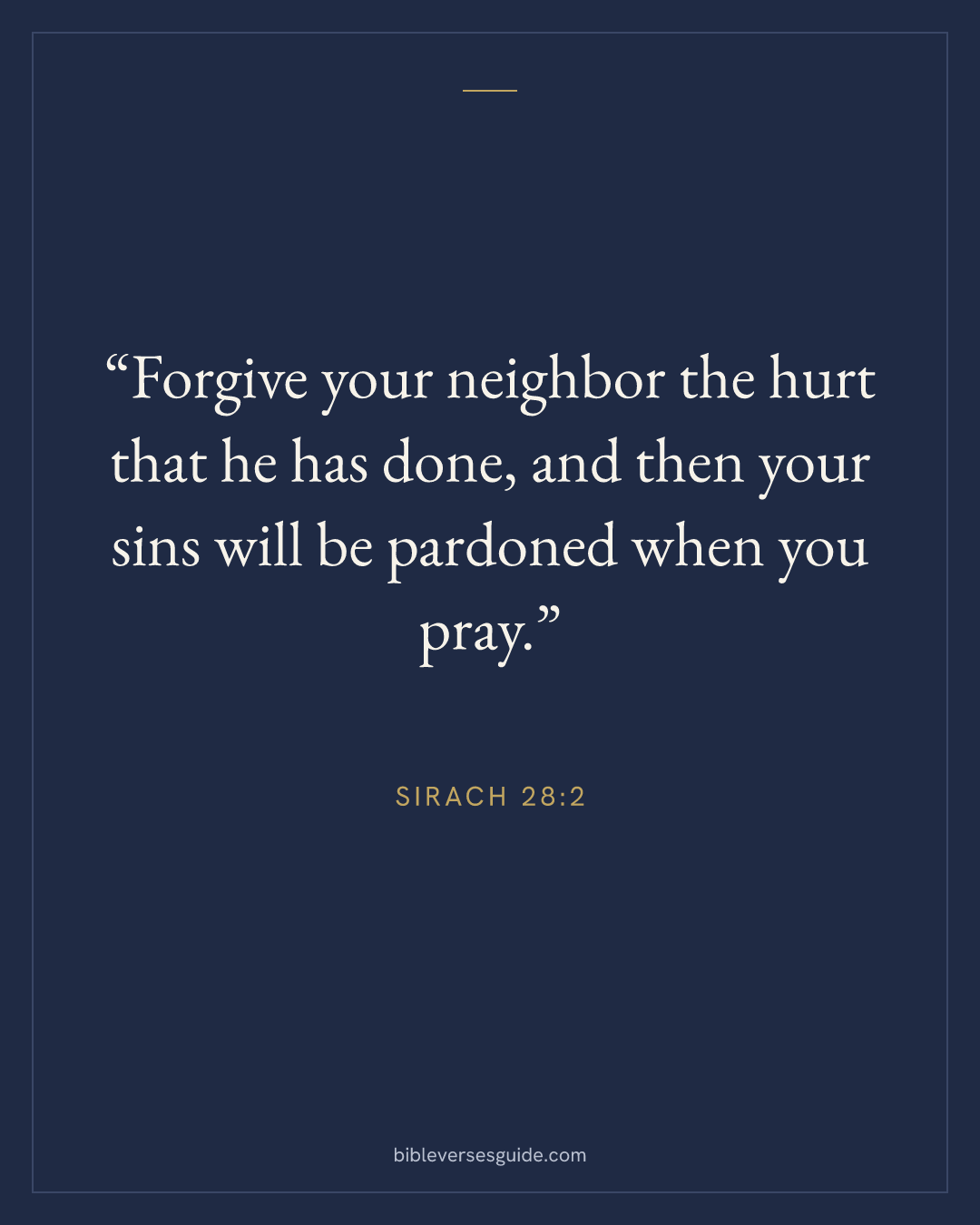
Forgive your neighbor the hurt that he has done,
and then your sins will be pardoned when you pray.
Latin correspondence unavailable for this passage.
Centuries before the Gospels, Sirach connects forgiving a neighbor with being forgiven in prayer.
Ben Sira’s wisdom, a deuterocanonical book

“Come now, and let’s reason together,” says the Lord:
“Though your sins are as scarlet, they shall be as white as snow.
Though they are red like crimson, they shall be as wool.
Et venite, et arguite me, dicit Dominus. Si fuerint peccata vestra ut coccinum, quasi nix dealbabuntur; et si fuerint rubra quasi vermiculus, velut lana alba erunt.Isaias 1:18 · Clementine Vulgate
God invites His people to reason together: sins like scarlet made white as snow.
Isaiah’s opening call to Judah


How this differs from related topics
Forgiveness is not the same as reconciliation or excusing harm. Scripture links forgiving to being forgiven, but it also calls wrongs wrong; forgiving someone does not require returning to an unsafe situation.