What this page covers
What does the Bible say love is, and how are God’s love and human love connected?
The central love passages: the commandments to love God and neighbor, the description of love in 1 Corinthians 13, and the New Testament’s insistence that human love answers God’s love. A dedicated guide explores God’s love in depth.
The New Testament usually writes love with the Greek word agapē: a love defined less by feeling than by commitment to another’s good. It is the word Paul uses in 1 Corinthians 13 and the word John uses when he says “God is love.” Older English Bibles sometimes translated it charity.
Two commandments, one love
When asked for the greatest commandment, Jesus answered with two, quoted from the Law of Moses: love God with all your heart, soul and mind, and love your neighbor as yourself (Matthew 22:37–39). Neither was new — both come from Deuteronomy and Leviticus — but joining them made a claim: you cannot separate love for God from love for people.
Love as a response
The First Letter of John puts the order plainly: “We love Him, because He first loved us” (1 John 4:19). In Paul’s words, God showed His love “while we were yet sinners” (Romans 5:8). Human love, in this view, is not how people earn God’s love but how they answer it.
What love looks like
1 Corinthians 13:4–7 is read at many weddings, and it fits them well. But Paul first wrote it to a church divided by rivalry and status, where some members were proud of their spiritual gifts. His point was that love is more important than any impressive ability. The qualities he lists — patience, kindness, not keeping a record of wrongs — are about community as much as romance.
Go deeper
For the many ways Scripture describes God’s love — faithful, compassionate, unconditional in its offer — see the guide What Scripture means by God’s love.
Passages, in context
Love is patient and is kind. Love doesn’t envy. Love doesn’t brag, is not proud, doesn’t behave itself inappropriately, doesn’t seek its own way, is not provoked, takes no account of evil; doesn’t rejoice in unrighteousness, but rejoices with the truth; bears all things, believes all things, hopes all things, and endures all things.
Caritas patiens est, benigna est. Caritas non æmulatur, non agit perperam, non inflatur, non est ambitiosa, non quærit quæ sua sunt, non irritatur, non cogitat malum, non gaudet super iniquitate, congaudet autem veritati: omnia suffert, omnia credit, omnia sperat, omnia sustinet.1 ad Corinthios 13:4–7 · Clementine Vulgate
The Bible’s best-known description of love — patient, kind, not self-seeking — written to correct a community that prized impressive gifts over care for one another.
Paul to a divided church in Corinth


Jesus said to him, “‘You shall love the Lord your God with all your heart, with all your soul, and with all your mind.’ This is the first and great commandment. A second likewise is this, ‘You shall love your neighbor as yourself.’
Ait illi Jesus: Diliges Dominum Deum tuum ex toto corde tuo, et in tota anima tua, et in tota mente tua. Hoc est maximum, et primum mandatum. Secundum autem simile est huic: Diliges proximum tuum, sicut teipsum.Matthæus 22:37–39 · Clementine Vulgate
Jesus joins two commandments from the Law — love God, love your neighbor — and says everything else hangs on them.
Jesus answering a question in the temple


Beloved, let’s love one another, for love is of God; and everyone who loves has been born of God and knows God. He who doesn’t love doesn’t know God, for God is love.
Carissimi, diligamus nos invicem: quia caritas ex Deo est. Et omnis qui diligit, ex Deo natus est, et cognoscit Deum. Qui non diligit, non novit Deum: quoniam Deus caritas est.1 Joannis 4:7–8 · Clementine Vulgate
Love comes from God, and “God is love”: the source of human love is God’s own nature.
The First Letter of John
We love Him, because He first loved us.
Nos ergo diligamus Deum, quoniam Deus prior dilexit nos.1 Joannis 4:19 · Clementine Vulgate
“We love Him, because He first loved us” — human love as response.
The First Letter of John


“This is My commandment, that you love one another, even as I have loved you. Greater love has no one than this, that someone lay down his life for his friends.
Hoc est præceptum meum, ut diligatis invicem, sicut dilexi vos. Majorem hac dilectionem nemo habet, ut animam suam ponat qui pro amicis suis.Joannes 15:12–13 · Clementine Vulgate
Jesus sets His own self-giving as the measure of love for one another.
Jesus at the Last Supper


But God commends His own love toward us, in that while we were yet sinners, Christ died for us.
Commendat autem caritatem suam Deus in nobis: quoniam cum adhuc peccatores essemus, secundum tempus,ad Romanos 5:8 · Clementine Vulgate
God’s love is shown while people were still sinners — love that does not wait to be earned.
Paul to the church in Rome


Owe no one anything, except to love one another; for he who loves his neighbor has fulfilled the law. For the commandments, “You shall not commit adultery,” “You shall not murder,” “You shall not steal,” “You shall not covet,” and whatever other commandments there are, are all summed up in this saying, namely, “You shall love your neighbor as yourself.” Love doesn’t harm a neighbor. Love therefore is the fulfillment of the law.
Nemini quidquam debeatis, nisi ut invicem diligatis: qui enim diligit proximum, legem implevit. Nam: Non adultabis: non occides: non furaberis: non falsum testimonium dices: non concupisces: et si quod est aliud mandatum, in hoc verbo instauratur: diliges proximum tuum sicut teipsum. Dilectio proximi malum non operatur. Plenitudo ergo legis est dilectio.ad Romanos 13:8–10 · Clementine Vulgate
Love fulfills the law: Paul gathers the commandments into one.
Paul on life in community
Above all these things, walk in love, which is the bond of perfection.
Super omnia autem hæc, caritatem habete, quod est vinculum perfectionis:ad Colossenses 3:14 · Clementine Vulgate
Love is “the bond of perfection” — the garment over all the other virtues.
Paul to the Colossians


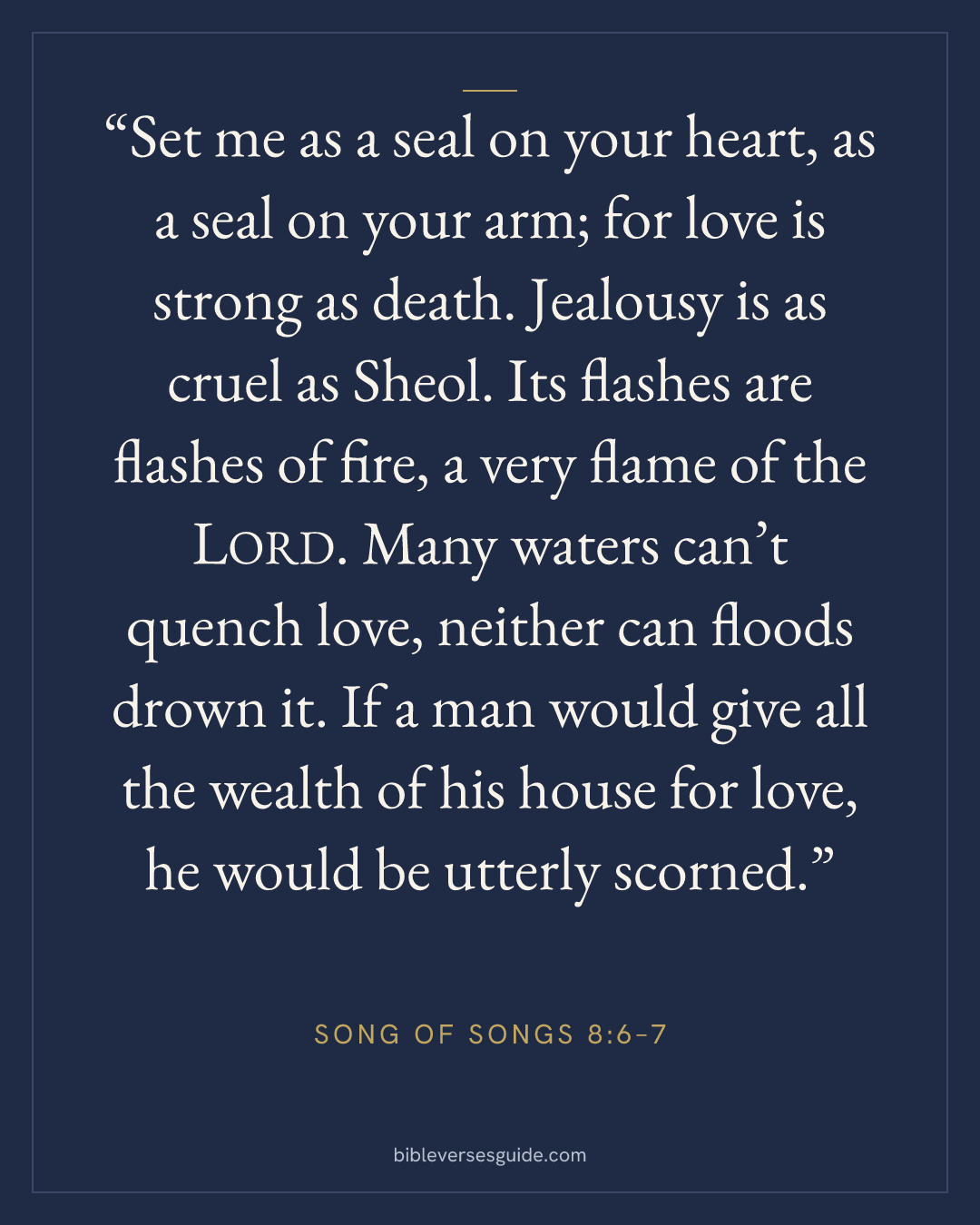
Set me as a seal on your heart,
as a seal on your arm;
for love is strong as death.
Jealousy is as cruel as Sheol.
Its flashes are flashes of fire,
a very flame of the Lord.
Many waters can’t quench love,
neither can floods drown it.
If a man would give all the wealth of his house for love,
he would be utterly scorned.
Sponsa Pone me ut signaculum super cor tuum, ut signaculum super brachium tuum, quia fortis est ut mors dilectio, dura sicut infernus æmulatio: lampades ejus lampades ignis atque flammarum. Aquæ multæ non potuerunt extinguere caritatem, nec flumina obruent illam. Si dederit homo omnem substantiam domus suæ pro dilectione, quasi nihil despiciet eam.Canticum Canticorum 8:6–7 · Clementine Vulgate
Love as strong as death, which many waters cannot quench: the Bible’s poetry of human love.
The Song of Songs’ climax

How this differs from related topics
This page covers love broadly. The guide “What Scripture means by God’s love” goes deeper into God’s love specifically, and marriage, family and friendship each have their own page in this family. Romantic love appears here (Song of Songs) but is not the page’s focus.