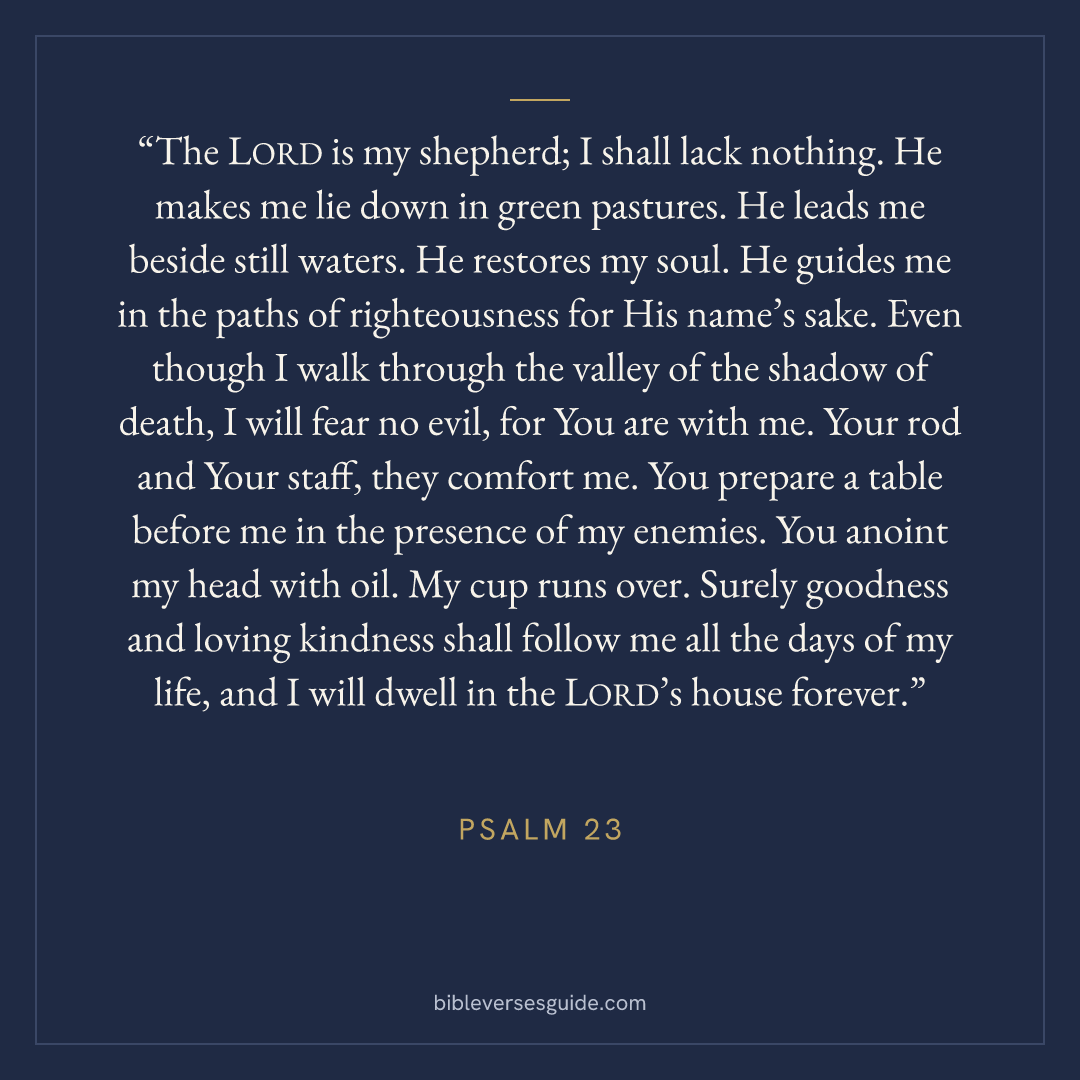
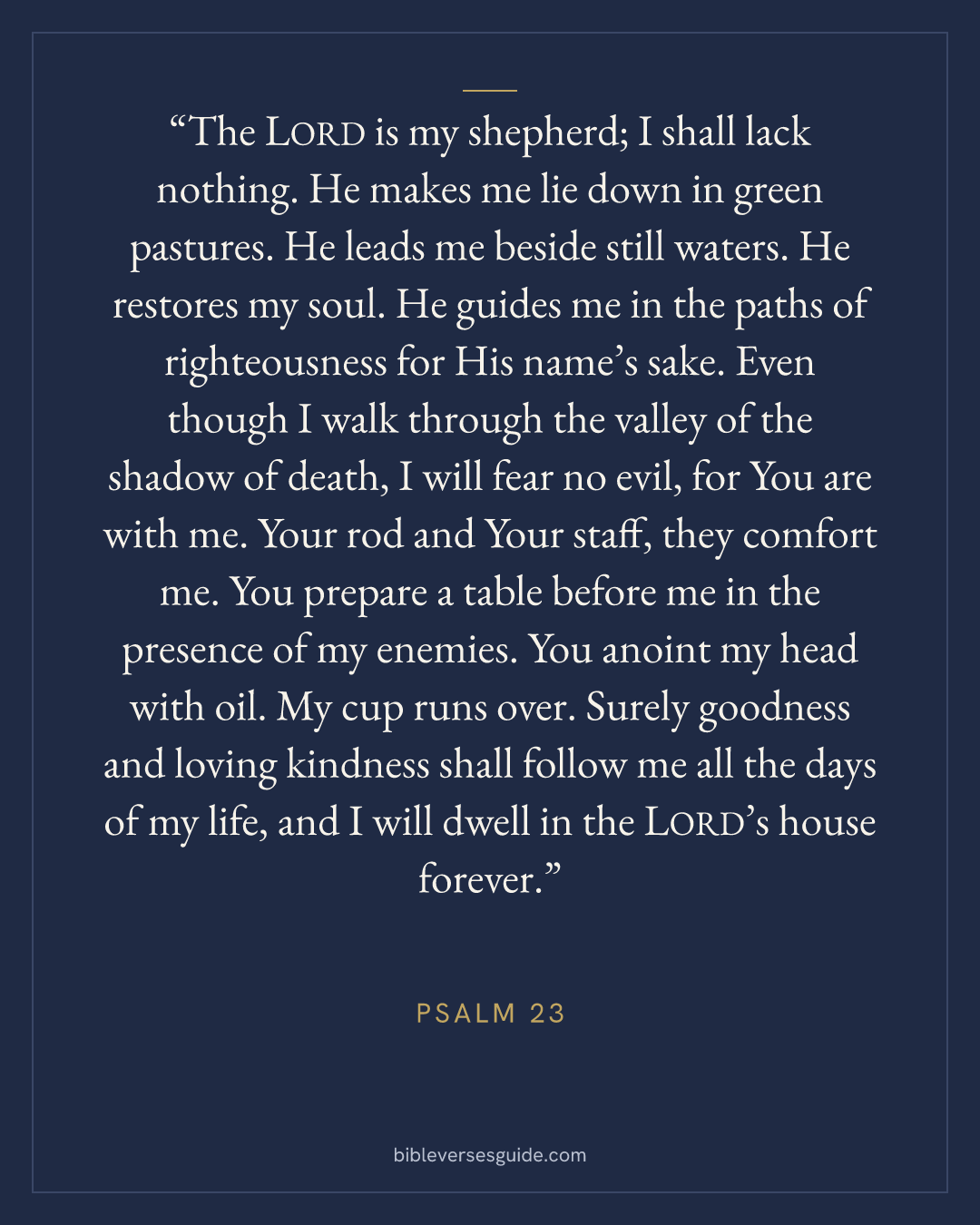
The Lord is my shepherd;
I shall lack nothing.
He makes me lie down in green pastures.
He leads me beside still waters.
He restores my soul.
He guides me in the paths of righteousness for His name’s sake.
Even though I walk through the valley of the shadow of death,
I will fear no evil, for You are with me.
Your rod and Your staff,
they comfort me.
You prepare a table before me
in the presence of my enemies.
You anoint my head with oil.
My cup runs over.
Surely goodness and loving kindness shall follow me all the days of my life,
and I will dwell in the Lord’s house forever.
Psalmus David. Dominus regit me, et nihil mihi deerit: in loco pascuæ, ibi me collocavit. Super aquam refectionis educavit me; animam meam convertit. Deduxit me super semitas justitiæ propter nomen suum. Nam etsi ambulavero in medio umbræ mortis, non timebo mala, quoniam tu mecum es. Virga tua, et baculus tuus, ipsa me consolata sunt. Parasti in conspectu meo mensam adversus eos qui tribulant me; impinguasti in oleo caput meum: et calix meus inebrians, quam præclarus est! Et misericordia tua subsequetur me omnibus diebus vitæ meæ; et ut inhabitem in domo Domini in longitudinem dierum.Vulgate Psalm 22:1–6 · Clementine Vulgate
Explanation — not a translation
In brief
Psalm 23 describes God as a shepherd who provides, guides and protects, and then as a host who welcomes a guest to a generous table. Its confidence is not that nothing bad will happen, but that God is present in every place the psalmist must go — including the darkest valley.
The shepherd
The superscription calls this “A Psalm by David,” who, according to the books of Samuel, began as a shepherd. In the ancient Near East, kings were often called shepherds of their people. Here the king calls God his shepherd. The images are practical: green pastures and still waters (rest and nourishment), paths of righteousness (guidance), rod and staff (protection and correction).
The Lord is my shepherd;
I shall lack nothing.
He makes me lie down in green pastures.
He leads me beside still waters.
He restores my soul.
He guides me in the paths of righteousness for His name’s sake.
Psalmus David. Dominus regit me, et nihil mihi deerit: in loco pascuæ, ibi me collocavit. Super aquam refectionis educavit me; animam meam convertit. Deduxit me super semitas justitiæ propter nomen suum.Vulgate Psalm 22:1–3 · Clementine Vulgate
The valley
Even though I walk through the valley of the shadow of death,
I will fear no evil, for You are with me.
Your rod and Your staff,
they comfort me.
Nam etsi ambulavero in medio umbræ mortis, non timebo mala, quoniam tu mecum es. Virga tua, et baculus tuus, ipsa me consolata sunt.Vulgate Psalm 22:4 · Clementine Vulgate
The Hebrew phrase translated “shadow of death” can also mean “deep darkness.” Either way, the psalmist walks through it rather than around it.
Notice the shift in the middle of the psalm. Verses 1–3 speak about God (“He”); verse 4 speaks to God (“You are with me”). In the darkest place, description turns into address.
The table
You prepare a table before me
in the presence of my enemies.
You anoint my head with oil.
My cup runs over.
Surely goodness and loving kindness shall follow me all the days of my life,
and I will dwell in the Lord’s house forever.
Parasti in conspectu meo mensam adversus eos qui tribulant me; impinguasti in oleo caput meum: et calix meus inebrians, quam præclarus est! Et misericordia tua subsequetur me omnibus diebus vitæ meæ; et ut inhabitem in domo Domini in longitudinem dierum.Vulgate Psalm 22:5–6 · Clementine Vulgate
The second image is hospitality. A host prepares a meal “in the presence of my enemies” — the danger has not disappeared, but the guest is safe under the host’s protection. Anointing with oil was a mark of honor for a guest. The final verse speaks of goodness and loving kindness that follow (the Hebrew verb can mean pursue), and of dwelling in the LORD’s house.
What it doesn’t necessarily mean
Psalm 23 is not a promise that believers will avoid hardship; the valley is part of the journey. Nor does it describe a life of passive ease — sheep are led, corrected and moved on.
How it has been read
Jewish tradition prays Psalm 23 at Sabbath meals and in times of mourning. Christians have read it alongside Jesus’ words “I am the good shepherd” (John 10:11), and many have heard the table and the oil as echoes of the Eucharist and baptism or anointing. It is among the most common readings at funerals across traditions.
Numbering note
In the Clementine Vulgate and some older Catholic Bibles, this psalm is numbered 22 (Dominus regit me). The Latin appears beside the English on this site only where the verses are verified to correspond.