What this page covers
What does the Bible say to someone going through a hard time?
Scripture for hardship in general: uncertainty, setbacks, long trials. Grief has its own page; so do anxiety (a feeling) and strength (courage and endurance).
When life is hard, the Bible offers company before it offers answers. Some of its most important prayers are complaints: “How long, LORD?” (Psalm 13:1–2). The presence of these prayers in Scripture is itself a kind of permission. Faith, in the biblical pattern, can argue with God and still hold on.
God near, not far
Psalm 34:18 says the LORD is near to the brokenhearted. Psalm 23:4 pictures walking through the darkest valley, not around it. Isaiah 43:2 promises presence in the waters and the fire. None of these passages says the hard thing will not happen; each says that God will be there when it does.
When you can’t see the way
For seasons of uncertainty, the wisdom tradition counsels trust over certainty (Proverbs 3:5–6). Psalm 119 calls God’s word a lamp to the feet (Psalm 119:105) — light enough for the next step.
Reading Romans 8:28 carefully
Romans 8:28 is often quoted to mean that everything happens for a reason. In the WEB-C, Paul writes that “all things work together for good for those who love God”; some ancient manuscripts, followed by several modern translations, make God the explicit subject. Either way the claim is about God’s purpose for His people, not that every event is good. In context (Romans 8:18-39) it sits alongside groaning, waiting and hope.
Go deeper
The guide Trusting God in difficult times: what the Psalms of lament actually say explores how the Bible’s laments move from complaint to trust — and why they do not always arrive there quickly.
Passages, in context
The Lord is near to those who have a broken heart,
and saves those who have a crushed spirit.
Juxta est Dominus iis qui tribulato sunt corde, et humiles spiritu salvabit.Vulgate Psalm 33:19 · Clementine Vulgate
God is near the brokenhearted — nearness, not distance, in the worst moments.
A psalm of David
Trust in the Lord with all your heart,
and don’t lean on your own understanding.
In all your ways acknowledge Him,
and He will make your paths straight.
Habe fiduciam in Domino ex toto corde tuo, et ne innitaris prudentiæ tuæ. In omnibus viis tuis cogita illum, et ipse diriget gressus tuos.Proverbia 3:5–6 · Clementine Vulgate
Trust when you cannot see the way: the wisdom tradition’s guidance for decisions under uncertainty.
Wisdom for decisions


Your word is a lamp to my feet,
and a light for my path.
Nun Lucerna pedibus meis verbum tuum, et lumen semitis meis.Vulgate Psalm 118:105 · Clementine Vulgate
A lamp for the next step, not a floodlight on the whole road — guidance one step at a time.
The long psalm in praise of God’s word


Even though I walk through the valley of the shadow of death,
I will fear no evil, for You are with me.
Your rod and Your staff,
they comfort me.
Nam etsi ambulavero in medio umbræ mortis, non timebo mala, quoniam tu mecum es. Virga tua, et baculus tuus, ipsa me consolata sunt.Vulgate Psalm 22:4 · Clementine Vulgate
Walking through the darkest valley without fear because the shepherd is present — the valley is not avoided.
The shepherd psalm


How long, Lord?
Will You forget me forever?
How long will You hide Your face from me?
How long shall I take counsel in my soul,
having sorrow in my heart every day?
How long shall my enemy triumph over me?
Latin correspondence unavailable for this passage.
“How long?” A lament that complains to God openly — and is part of Scripture.
A psalm of David


When you pass through the waters, I will be with you,
and through the rivers, they will not overflow you.
When you walk through the fire, you will not be burned,
and flame will not scorch you.
Cum transieris per aquas, tecum ero, et flumina non operient te; cum ambulaveris in igne, non combureris, et flamma non ardebit in te.Isaias 43:2 · Clementine Vulgate
Passing through waters and fire, not around them: God’s promise of presence to Israel.
Comfort to Israel in exile
We are pressed on every side, yet not crushed; perplexed, yet not to despair; pursued, yet not forsaken; struck down, yet not destroyed;
In omnibus tribulationem patimur, sed non angustiamur: aporiamur, sed non destituimur: persecutionem patimur, sed non derelinquimur: dejicimur, sed non perimus:2 ad Corinthios 4:8–9 · Clementine Vulgate
Pressed but not crushed, perplexed but not in despair: Paul’s honest description of his own hardships.
Paul defending his ministry
We know that all things work together for good for those who love God, for those who are called according to His purpose.
Scimus autem quoniam diligentibus Deum omnia cooperantur in bonum, iis qui secundum propositum vocati sunt sancti.ad Romanos 8:28 · Clementine Vulgate
All things work together for good for those who love God — a claim about God’s purpose, not that every event is good.
Paul’s letter to Rome
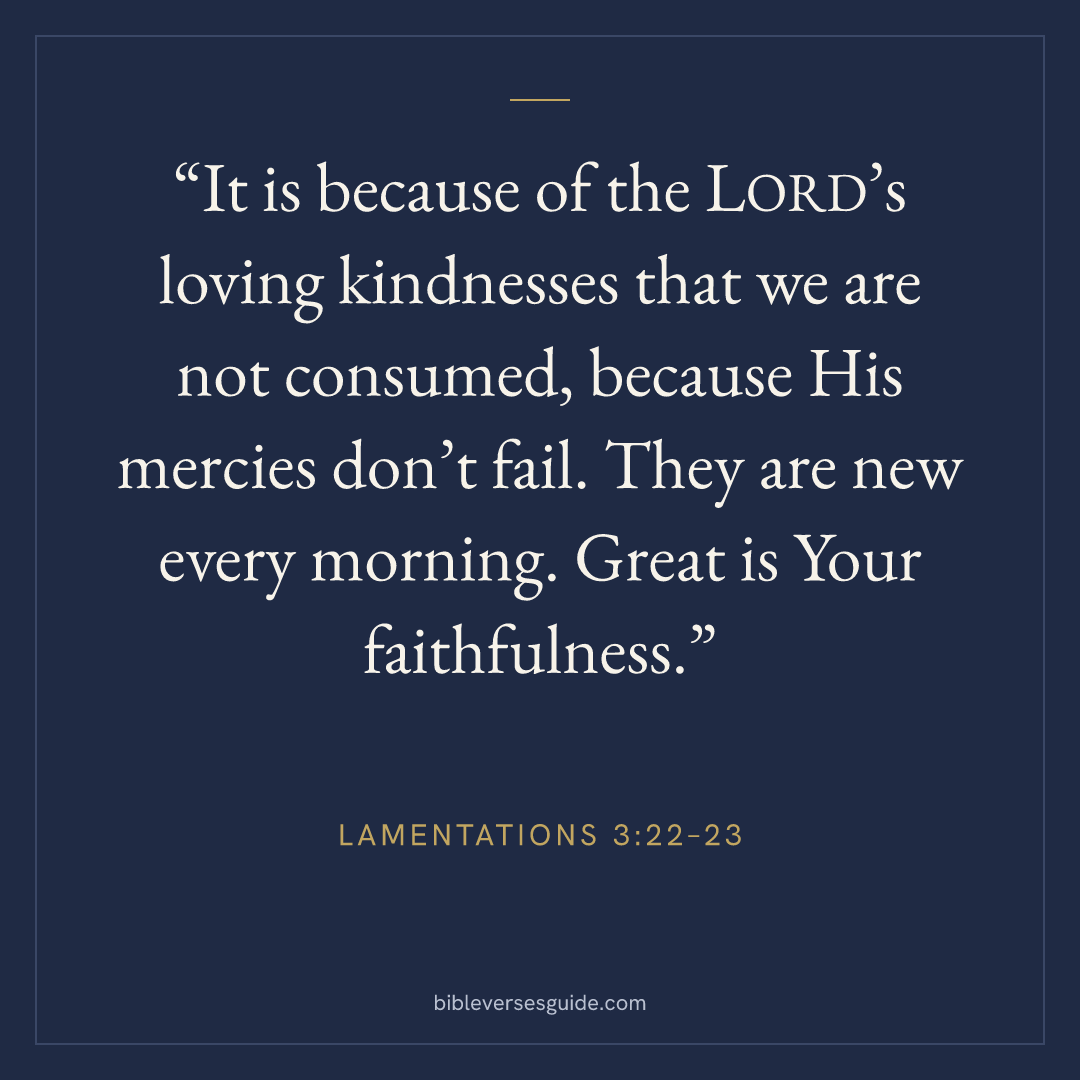
It is because of the Lord’s loving kindnesses that we are not consumed,
because His mercies don’t fail.
They are new every morning.
Great is Your faithfulness.
Latin correspondence unavailable for this passage.
Mercies new every morning, written in a ruined city.
A lament after Jerusalem’s fall
How this differs from related topics
This page is about circumstances — when life is hard. Grief, anxiety and strength each have their own pages with passages chosen for those needs. The guide “Trusting God in difficult times” goes deeper into the Psalms of lament.