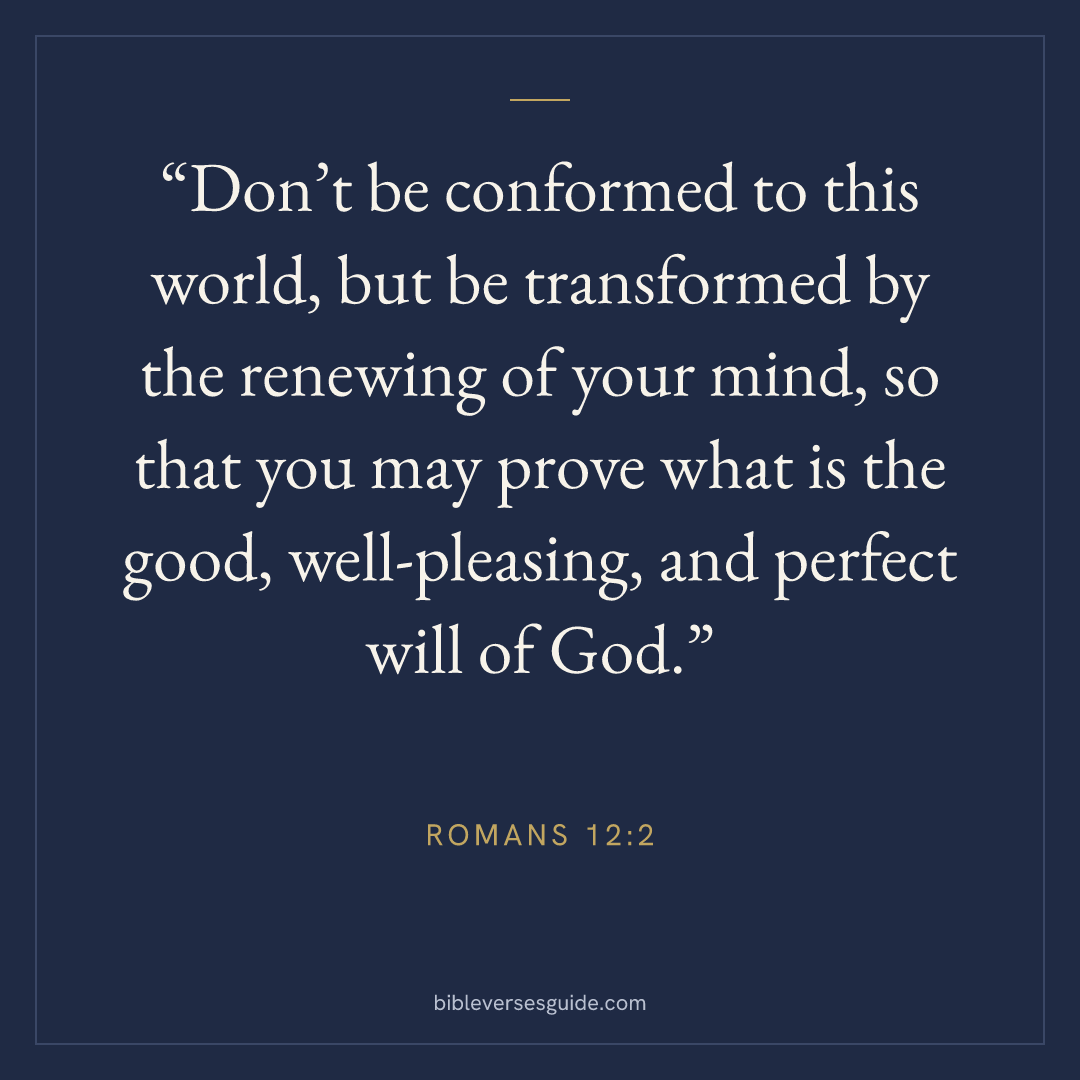
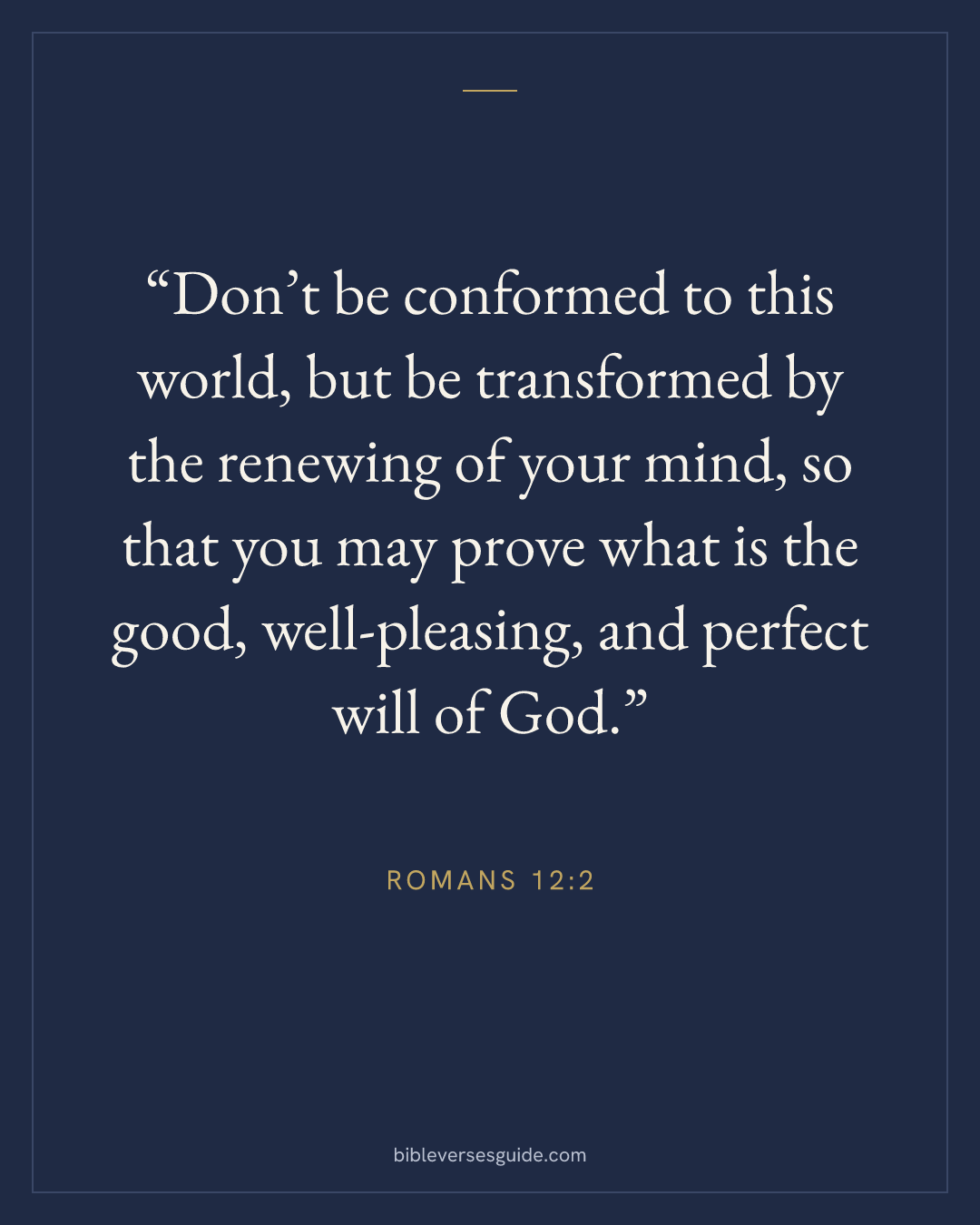
Don’t be conformed to this world, but be transformed by the renewing of your mind, so that you may prove what is the good, well-pleasing, and perfect will of God.
Et nolite conformari huic sæculo, sed reformamini in novitate sensus vestri: ut probetis quæ sit voluntas Dei bona, et beneplacens, et perfecta.ad Romanos 12:2 · Clementine Vulgate
Explanation — not a translation
In brief
Paul urges the Christians in Rome not to let “this world” shape them, but to be transformed by the renewing of their minds, so that they can recognize God’s will: what is good, pleasing to Him and complete. The verse is the second half of a single thought that begins in Romans 12:1.
The setting
Romans is Paul’s longest letter, written to a church he had not yet visited. Chapters 1–11 set out what God has done: all people need His mercy, and in Christ He has shown it to Jews and Gentiles alike. Chapter 11 ends in praise.
Oh the depth of the riches both of the wisdom and the knowledge of God! How unsearchable are His judgments, and His ways past tracing out!
“For who has known the mind of the Lord?
Or who has been His counselor?”
“Or who has first given to Him,
and it will be repaid to him again?”
For of Him and through Him and to Him are all things. To Him be the glory for ever! Amen.
O altitudo divitiarum sapientiæ, et scientiæ Dei: quam incomprehensibilia sunt judicia ejus, et investigabiles viæ ejus! Quis enim cognovit sensum Domini? aut quis consiliarius ejus fuit? aut quis prior dedit illi, et retribuetur ei? Quoniam ex ipso, et per ipsum, et in ipso sunt omnia: ipsi gloria in sæcula. Amen.ad Romanos 11:33–36 · Clementine Vulgate
Paul’s doxology: “Oh the depth of the riches both of the wisdom and the knowledge of God!”
Then comes the turn to how Christians should live, and it starts with “therefore.”
Therefore I urge you, brothers, by the mercies of God, to present your bodies a living sacrifice, holy, acceptable to God, which is your spiritual service.
Obsecro itaque vos fratres per misericordiam Dei, ut exhibeatis corpora vestra hostiam viventem, sanctam, Deo placentem, rationabile obsequium vestrum.ad Romanos 12:1 · Clementine Vulgate
“By the mercies of God”: the whole of life offered as worship.
Everything in verse 2 rests on verse 1. Paul does not say change, and God will be merciful. He says that because God has been merciful, His people can offer themselves to Him. The phrase translated “spiritual service” can also be rendered “reasonable worship”: the fitting response to such mercy is a whole life given back.
Key words
- “conformed” — the Greek verb suggests being pressed into a pattern or mold. Paul’s concern is that believers can be shaped, almost without noticing, by the assumptions around them.
- “this world” — literally “this age.” Paul thinks in terms of the present age, which is passing, and the age to come, which has already begun in Christ.
- “transformed” — the Greek verb (metamorphoō) is the one the Gospels use for Jesus’ transfiguration (Matthew 17:2) and that Paul uses in 2 Corinthians 3:18 of believers being changed “from glory to glory.” It describes a change from within that becomes visible.
- “renewing of your mind” — earlier in the letter Paul described people who refused to acknowledge God being given up to a reprobate mind (Romans 1:28). Here the mind is renewed. For Paul the mind is not only the intellect but the way a person sees, judges and chooses.
- “prove” — to test and discern. A renewed mind is able to recognize God’s will in real situations.
What it does and doesn’t mean
“Be transformed” is in the passive voice: the change is something God does, though believers cooperate with it. The verse is not a technique of positive thinking, and it is not a call to withdraw from culture or to reject everything outside the church. It asks believers to notice what is shaping them and to let God reshape them instead.
The “you” is plural. The next verses describe the church as one body with many gifts (Romans 12:3–8), and the rest of the chapter shows what a renewed mind looks like in practice: sincere love, humility, hospitality, and refusing to repay evil with evil.
How Christians read it
All traditions see this verse as a summary of the Christian life after conversion. Catholic and Orthodox Christians often connect the “living sacrifice” of 12:1 with offering oneself in the Eucharist, and describe the transformation as growth in holiness by grace, sustained by prayer and the sacraments; Orthodox writers speak of it as part of theosis, sharing in the life of God. Protestant traditions commonly call it sanctification, the lifelong work of the Holy Spirit in those who have been justified by faith. All agree the change is God’s gift that calls for a willing response.
Read it with
Ephesians 4:22–24 speaks of being “renewed in the spirit of your mind.” Philippians 2:5 asks believers to have the mind of Christ. 1 John 2:15–17 contrasts the passing world with the one who does God’s will. The Faith page gathers related passages.