What this page covers
What does the Bible say about marriage, and which passages are read at weddings?
The main passages on marriage, from Genesis to the New Testament, with notes on how they are used at weddings. Divorce is treated in a separate question page; love in general has its own topic.
Scripture’s teaching on marriage starts at creation. God says, “It is not good for the man to be alone” (Genesis 2:18), and near the chapter’s close a man and woman become “one flesh” (Genesis 2:24). When Jesus is asked about divorce, He goes back to that verse and adds, “What therefore God has joined together, let no man separate” (Mark 10:6–9).
Reading Ephesians 5 from verse 21
Ephesians 5:21–33 is often quoted from verse 22, “Wives, be subject to your own husbands.” But the passage begins a verse earlier: “subjecting yourselves to one another in the fear of Christ.” In the best-attested Greek text, verse 22 has no verb of its own and borrows it from verse 21. Paul then gives husbands the longer charge: to love their wives “even as Christ also loved the assembly and gave Himself up for her.”
Christians read the language of headship differently. Some understand it as a real but servant-shaped responsibility given to husbands; others read it as Paul reshaping the household customs of his day toward mutual self-giving. Pope John Paul II, writing on the dignity of women in 1988, stressed the mutual subjection of husband and wife. On every reading, the model is Christ, who gave Himself up. The passage cannot be used to justify control, intimidation or abuse.
Marriage in different traditions
Catholics and Orthodox Christians receive marriage as a sacrament; Paul’s phrase “This mystery is great” (Ephesians 5:32) was rendered sacramentum in the Latin Vulgate. Most Protestant traditions honor marriage as a holy covenant instituted by God but do not count it among the sacraments. All agree that it deserves honor (Hebrews 13:4). For divorce and remarriage, where traditions differ more widely, see What does the Bible say about divorce?
Readings for weddings
Couples often choose 1 Corinthians 13:4–7, Song of Songs 8:6–7, Colossians 3:12–14 or the Genesis creation account. Catholic weddings may also use Tobias and Sarah’s prayer (Tobit 8:5–8), from a book in Catholic and Orthodox Bibles. Ruth 1:16–17 is popular too, though Ruth said it to her mother-in-law; it is a vow of loyalty that fits a wedding without being about one. The Song of Songs has also long been read as a picture of God’s love for His people, and its plain sense, the love of a couple, is part of why it belongs here.
If you are not safe
No passage on this page asks anyone to remain in danger. Churches across traditions, including the U.S. Catholic bishops in their statement on domestic violence, say that no one is expected to stay in an abusive marriage. In the United States, the National Domestic Violence Hotline is available at 1-800-799-7233; in an emergency, call 911.
Passages, in context
Therefore a man will leave his father and his mother, and will join with his wife, and they will be one flesh.
Quam ob rem relinquet homo patrem suum, et matrem, et adhærebit uxori suæ: et erunt duo in carne una.Genesis 2:24 · Clementine Vulgate
Leaving, joining and becoming “one flesh”: the verse Jesus and Paul both quote when they speak about marriage.
The second creation account, after God says it is not good for the man to be alone
But from the beginning of the creation, God made them male and female. For this cause a man will leave his father and mother, and will join to his wife, and the two will become one flesh, so that they are no longer two, but one flesh. What therefore God has joined together, let no man separate.”
ab initio autem creaturæ masculum et feminam fecit eos Deus. Propter hoc relinquet homo patrem suum et matrem, et adhærebit ad uxorem suam: et erunt duo in carne una. Itaque jam non sunt duo, sed una caro. Quod ergo Deus conjunxit, homo non separet.Marcus 10:6–9 · Clementine Vulgate
Jesus goes back past the law on divorce to creation itself and concludes, “What therefore God has joined together, let no man separate.”
Jesus answering a test question about divorce
subjecting yourselves to one another in the fear of Christ. Wives, be subject to your own husbands, as to the Lord. For the husband is the head of the wife, as Christ also is the head of the assembly, being Himself the savior of the body. But as the assembly is subject to Christ, so let the wives also be to their own husbands in everything. Husbands, love your wives, even as Christ also loved the assembly and gave Himself up for her, that He might sanctify her, having cleansed her by the washing of water with the word, that He might present the assembly to Himself gloriously, not having spot or wrinkle or any such thing, but that she should be holy and without defect. Even so husbands also ought to love their own wives as their own bodies. He who loves his own wife loves himself. For no man ever hated his own flesh, but nourishes and cherishes it, even as the Lord also does the assembly, because we are members of His body, of His flesh and bones. “For this cause a man will leave his father and mother and will be joined to his wife. Then the two will become one flesh.” This mystery is great, but I speak concerning Christ and the assembly. Nevertheless each of you must also love his own wife even as himself; and let the wife see that she respects her husband.
subjecti invicem in timore Christi. Mulieres viris suis subditæ sint, sicut Domino: quoniam vir caput est mulieris, sicut Christus caput est Ecclesiæ: ipse, salvator corporis ejus. Sed sicut Ecclesia subjecta est Christo, ita et mulieres viris suis in omnibus. Viri, diligite uxores vestras, sicut et Christus dilexit Ecclesiam, et seipsum tradidit pro ea, ut illam sanctificaret, mundans lavacro aquæ in verbo vitæ, ut exhiberet ipse sibi gloriosam Ecclesiam, non habentem maculam, aut rugam, aut aliquid hujusmodi, sed ut sit sancta et immaculata. Ita et viri debent diligere uxores suas ut corpora sua. Qui suam uxorem diligit, seipsum diligit. Nemo enim umquam carnem suam odio habuit: sed nutrit et fovet eam, sicut et Christus Ecclesiam: quia membra sumus corporis ejus, de carne ejus et de ossibus ejus. Propter hoc relinquet homo patrem et matrem suam, et adhærebit uxori suæ, et erunt duo in carne una. Sacramentum hoc magnum est, ego autem dico in Christo et in Ecclesia. Verumtamen et vos singuli, unusquisque uxorem suam sicut seipsum diligat: uxor autem timeat virum suum.ad Ephesios 5:21–33 · Clementine Vulgate
Paul’s fullest teaching on marriage, which begins with mutual submission “in the fear of Christ” and measures a husband’s love by Christ, who “gave Himself up for her.”
Paul’s instructions for Christian households


Love is patient and is kind. Love doesn’t envy. Love doesn’t brag, is not proud, doesn’t behave itself inappropriately, doesn’t seek its own way, is not provoked, takes no account of evil; doesn’t rejoice in unrighteousness, but rejoices with the truth; bears all things, believes all things, hopes all things, and endures all things.
Caritas patiens est, benigna est. Caritas non æmulatur, non agit perperam, non inflatur, non est ambitiosa, non quærit quæ sua sunt, non irritatur, non cogitat malum, non gaudet super iniquitate, congaudet autem veritati: omnia suffert, omnia credit, omnia sperat, omnia sustinet.1 ad Corinthios 13:4–7 · Clementine Vulgate
The most common wedding reading. Written about life in a church community, it describes the patient, unselfish love a marriage needs day to day.
Paul to a divided church in Corinth
Set me as a seal on your heart,
as a seal on your arm;
for love is strong as death.
Jealousy is as cruel as Sheol.
Its flashes are flashes of fire,
a very flame of the Lord.
Many waters can’t quench love,
neither can floods drown it.
If a man would give all the wealth of his house for love,
he would be utterly scorned.
Sponsa Pone me ut signaculum super cor tuum, ut signaculum super brachium tuum, quia fortis est ut mors dilectio, dura sicut infernus æmulatio: lampades ejus lampades ignis atque flammarum. Aquæ multæ non potuerunt extinguere caritatem, nec flumina obruent illam. Si dederit homo omnem substantiam domus suæ pro dilectione, quasi nihil despiciet eam.Canticum Canticorum 8:6–7 · Clementine Vulgate
Love “strong as death” that “many waters can’t quench”: Scripture celebrating the love of a bride and groom.
The climax of the Song of Songs
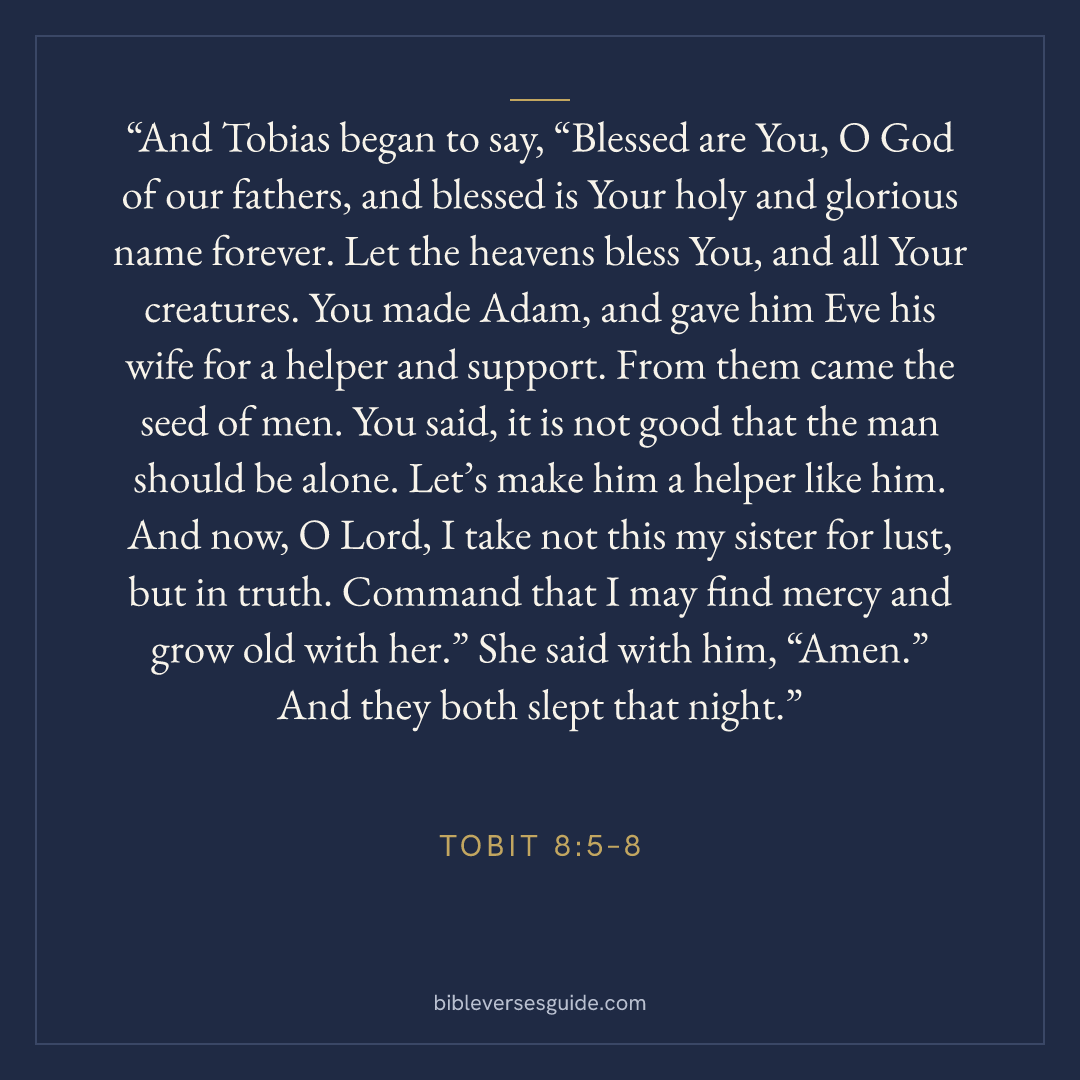
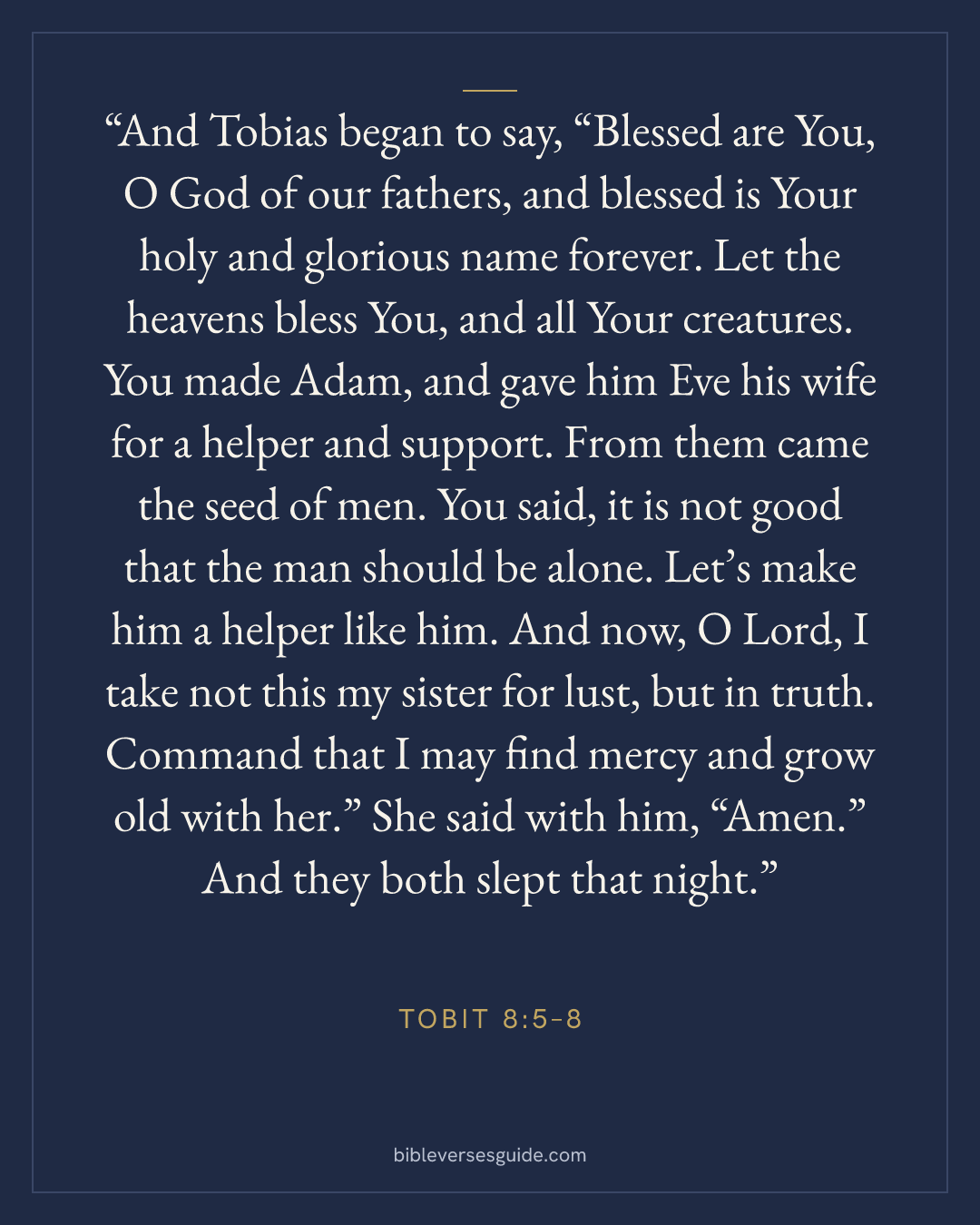
And Tobias began to say, “Blessed are You, O God of our fathers, and blessed is Your holy and glorious name forever. Let the heavens bless You, and all Your creatures. You made Adam, and gave him Eve his wife for a helper and support. From them came the seed of men. You said, it is not good that the man should be alone. Let’s make him a helper like him. And now, O Lord, I take not this my sister for lust, but in truth. Command that I may find mercy and grow old with her.” She said with him, “Amen.” And they both slept that night.
Latin correspondence unavailable for this passage.
A newly married couple begin by praying together, and Tobias asks to “grow old with her.” One of the Old Testament readings offered for Catholic weddings.
Tobias and Sarah on their wedding night, in a deuterocanonical book
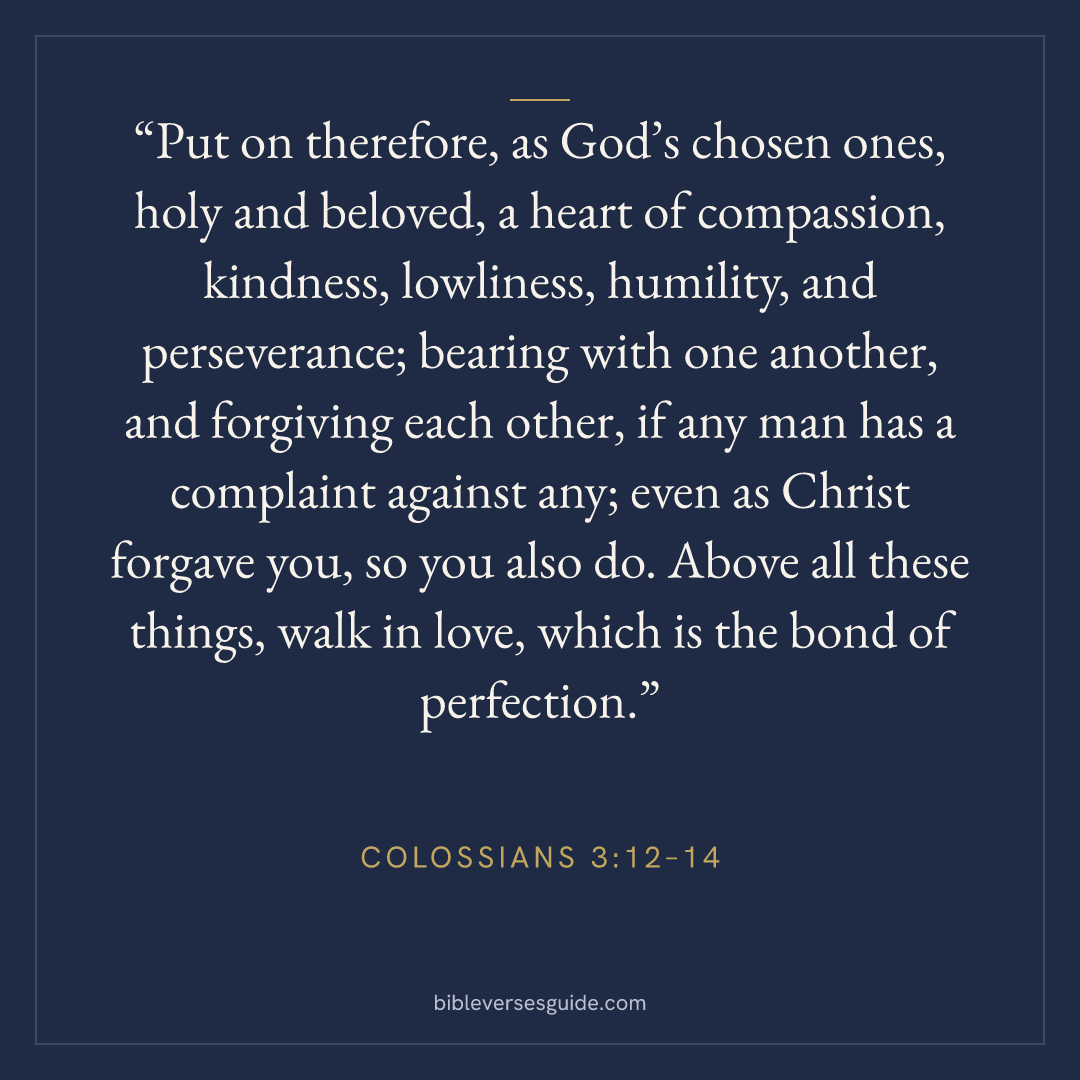
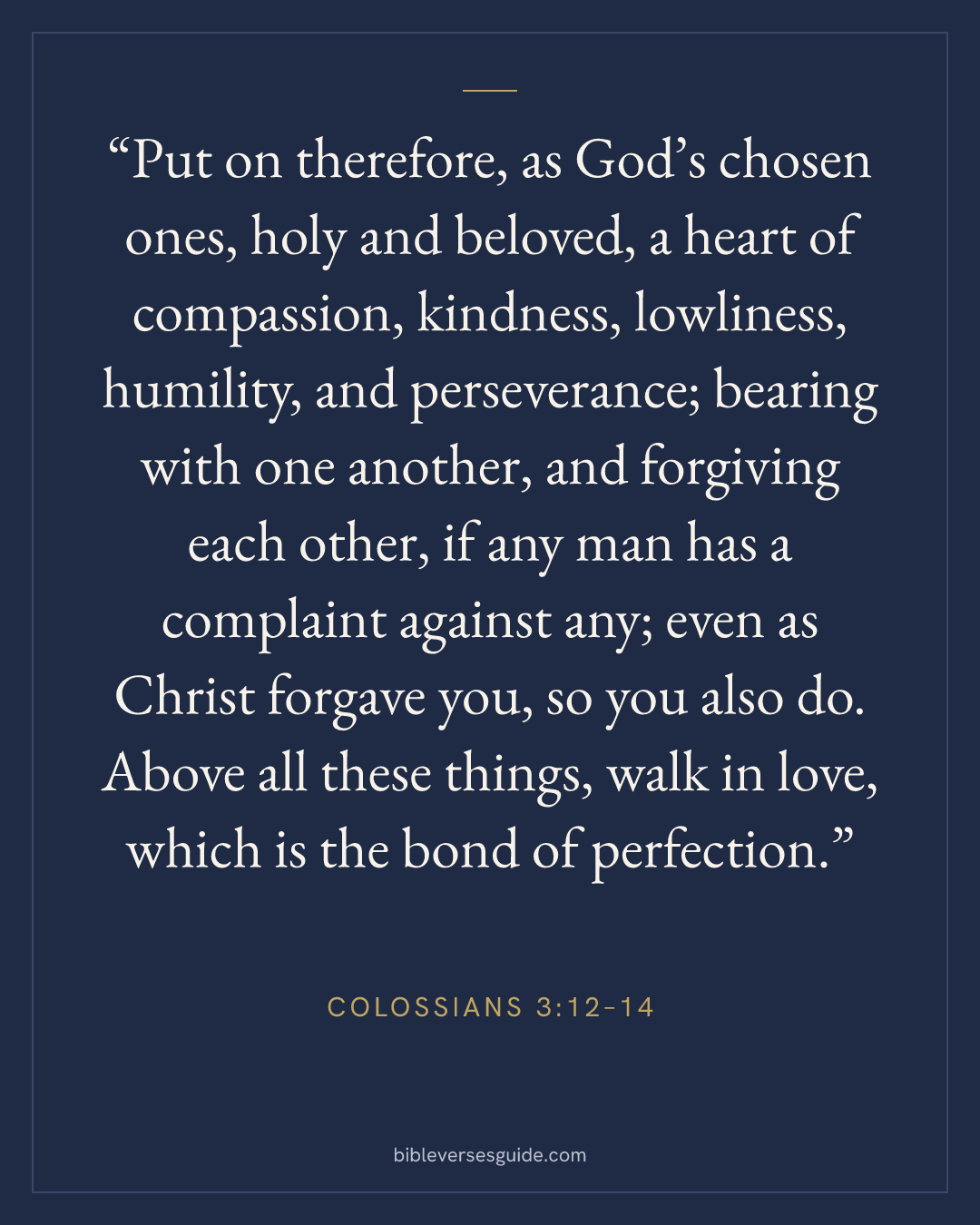
Put on therefore, as God’s chosen ones, holy and beloved, a heart of compassion, kindness, lowliness, humility, and perseverance; bearing with one another, and forgiving each other, if any man has a complaint against any; even as Christ forgave you, so you also do. Above all these things, walk in love, which is the bond of perfection.
Induite vos ergo, sicut electi Dei, sancti, et dilecti, viscera misericordiæ, benignitatem, humilitatem, modestiam, patientiam: supportantes invicem, et donantes vobismetipsis si quis adversus aliquem habet querelam: sicut et Dominus donavit vobis, ita et vos. Super omnia autem hæc, caritatem habete, quod est vinculum perfectionis:ad Colossenses 3:12–14 · Clementine Vulgate
Compassion, patience, bearing with one another and forgiving: the ordinary virtues of a shared life, bound together by love.
Paul on life in a new community
Let marriage be held in honor among all, and let the bed be undefiled; but God will judge the sexually immoral and adulterers.
Honorabile connubium in omnibus, et thorus immaculatus. Fornicatores enim, et adulteros judicabit Deus.ad Hebræos 13:4 · Clementine Vulgate
“Let marriage be held in honor among all”: a short charge to the whole community to honor marriage.
Closing exhortations of the Letter to the Hebrews

Ruth said, “Don’t urge me to leave you, and to return from following you, for where you go, I will go; and where you stay, I will stay. Your people will be my people, and your God my God. Where you die, I will die, and there I will be buried. May the Lord do so to me, and more also, if anything but death parts you and me.”
Quæ respondit: Ne adverseris mihi ut relinquam te et abeam: quocumque enim perrexeris, pergam, et ubi morata fueris, et ego pariter morabor. Populus tuus populus meus, et Deus tuus Deus meus. Quæ te terra morientem susceperit, in ea moriar: ibique locum accipiam sepulturæ. Hæc mihi faciat Dominus, et hæc addat, si non sola mors me et te separaverit.Ruth 1:16–17 · Clementine Vulgate
Often read at weddings for its vow of lifelong loyalty, though Ruth spoke these words to Naomi, her mother-in-law, not to a husband.
Ruth and Naomi on the road from Moab
How this differs from related topics
Love covers love broadly, including the community setting of 1 Corinthians 13. Family covers parents, children and relatives. Divorce and remarriage are treated on their own question page, linked below. No passage here requires anyone to stay in an abusive or unsafe relationship; if you are in danger, please seek help.